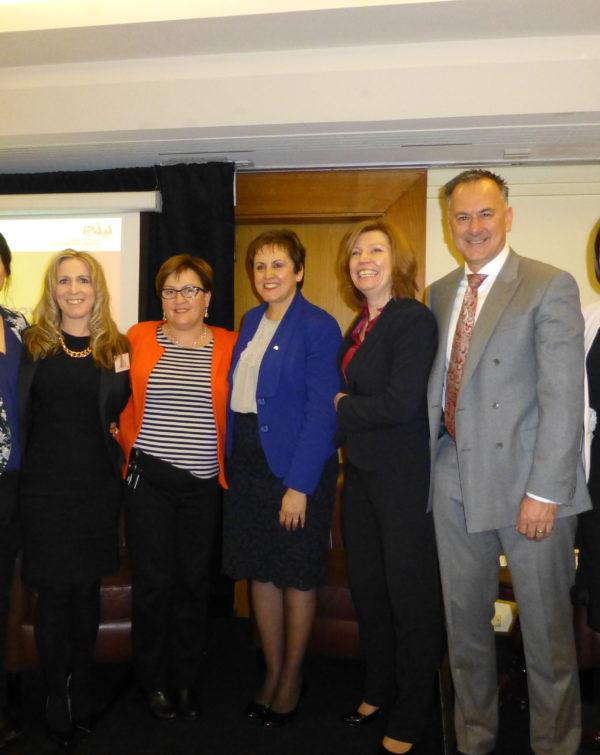
The Institute of Public Administration and the Equal Opportunity Commission hosted the Forum for South Australian executives, managers and supervisors on the 28th August 2015.
The way we work is changing. In recent years there has been a growing appreciation that organisations must respond to these dynamic shifts that are occurring within our society. Traditional patterns of working that involve ‘fixed pace, fixed time’ work no longer serve the current or future needs of the workplace and our society more generally. In light of this, a more flexible approach to working is required.1
The purpose of this Forum was to consider ways to create a more productive, dynamic and flexible public sector workforce that is able to adapt to the future needs of the State Government and the community.
Equal Opportunity Commissioner Anne Gale hosted the Forum and discussed the outcomes of the Flexible Workplace Futures project. Other speakers included the Department of the Premier and Cabinet’s Chief Executive Kym Winter-Dewhurst, who will shared his views on establishing a modern public sector in the context of flexible work, and Dr Eva Balan-Vnuk of Microsoft, who discussed the concept of technology as an enabler of activity-based working. You would also have heared from the Commissioner for Public Sector Employment, Erma Ranieri, who provided an industrial perspective, and Valuer-General Delfina Lanzilli, who discussed the implementation of flexible work at the State Valuation Office.
The Forum will considered strategies for increasing productivity, achieving workplace diversity and modernising the public sector.
New research shows that organisations that are more innovative, productive and perform better financially, are those that are more diverse. Around the world, organisations are applying technology and smarter ways of working to ensure that they are maximising their available resources. Smart leaders from governments in Scandinavia to internet giants like Google and well known Australian companies including Telstra, Commonwealth Bank, Aurizon, Qantas and Atlassian are tackling this for its major productivity benefits.
Guests joined international cluster expert Rodin Genoff, and Narelle Hooper, former editor of the Australian Financial Review’s BOSS magazine, as they explored the latest research on how gender and diversity drives innovation, and as they provided practical steps that individuals and agencies can take to accelerate innovation.
Guests also had the opportunity to hear the Premier and the Minister for the Public Sector explain why we need to strengthen our focus on building a more representative and diverse workforce, and why we need to reignite our efforts on achieving South Australia’s Strategic Plan Target 52, which aims for equal representation in executive positions in the public sector. Despite some progress, women still remain underrepresented in leadership roles. We know that the numbers of women in leadership need to be improved to make our State a leader in this space.
With your input, we will reshape the future of gender equity in South Australia and make our public sector fit for the 21st Century.
Edition 42 of Public Administration Today looked at Australia’s public service on the global stage, as well as how we learn from government globally. This issue included articles on topics including…
Competitiveness and productivity: Today asked the Productivity Commission to report on where Australia fits internationally
Innovate to compete internationally: Industry innovation and competitiveness remains a challenge for
Australian business, say Daniel Quinn and Mike Lawson.
International engagement means a safer world: Department of Infrastructure and Regional Development (DI&RD) Secretary, Mike Mrdak, says international engagement builds relationships and helps keep transportation – for Australians, overseas travellers and cargo – safe and secure.
Fruitful regional harvest: Australia’s trade diplomacy is on a roll. Over the past 14 months free trade agreements (FTAs) have been
struck with three major Asian trading partners.
Access the full issue below…

Edition 42
This edition of ‘Public Administration Today’ focused on the topic of ‘community and engagement, which included articles from influential figures across the public sector. Highlighted articles from this issue included…
To read the full edition please visit below…

Edition 41

In November 2012 we held one of our most successful forums (judging by the feedback received), Mental Health and the Workplace. This forum attracted over 400 public sector employees and our feedback is saying we can’t stop there. In collaboration with Beyondblue we are developing workshops that will address various topics under the banner of ‘Mental Health and the Workplace’.
This workshop is designed not only to educated managers as to their responsibilities in managing mental health of their staff, but also how to go about having those difficult conversations with staff.
Many managers are not aware what ‘mental health issues’ actually means in behavioural terms. An aim of this workshop is to de-mystify the term ‘mental health issues’ into real world, understandable concepts with real life case studies and examples. This forms the basis of developing skills for difficult conversations: understanding the problem. We will discuss why these are difficult conversations referencing our general reluctance to “pry into other’s private business”. What happens if that ‘private business’ starts to impact work performance? We will look at guidelines and obligations upon employers and managers under WHS as well as the Public Sector Act. Prior to engaging more formal processes, we will look at communication skills for managers in how to approach staff and how to frame conversations around the intersection between mental health and performance.

The Commissioner for Public Sector Employment Office of the Public Employment and Review in collaboration with the Institute of Public Administration Australia (IPAA) held a forum on Mental Health and the Workplace.
This forum considered mental health in the workplace, strategies to aid Employees and Managers and also covered relevant public sector legislation and policy. The South Australian Public Sector has a workforce of approximately 100,000 people. Based on Statistics from the Australian Bureau of Statistics 2008 (National Survey of Mental Health and Wellbeing) – this means that 6,200 of those people may be suffering from depression and 14,400 may be suffering from an anxiety disorder.
A mentally healthy workplace protects and promotes mental health and empowers people to seek help for depression and anxiety, for the benefits of the individual, organisation and community.
The Hon Minister O’Brien, Minister for the Public Sector and Minister for Finance will open this forum and the MC, speakers and panellists are as follows:
This forum considered strategies to aid employees and managers and also cover relevant Public Sector legislation and policy. Referring an employee for a medical examination, particularly in the case of mental incapacity, can be distressing for the employee and colleagues and sometimes for the family of the employee. It can however be a useful strategy to inform the formulation of management options best fitted to the circumstances and possible limitations of the employee.
Some questions that will be answered during the Mental health and the Workplace forum are:
Mr Warren McCann, Commissioner for Public Sector Employment will introduce the new Guidelines that have been prepared to assist Chief Executives and Managers involved in the consideration of possible reliance on Section 56.
Mental Health and the Workplace
Depression and anxiety disorders are common. Each year in Australia about one million adults experience depression and two million experience an anxiety disorder.
It can be difficult for people to admit they have depression or an anxiety disorder, and many people with these conditions are afraid to speak up at work in case they are treated differently. The actions of colleagues and managers can make a real difference to a person with a mental health problem.
The South Australian Public Sector has a workforce of approximately 100,000 people. Based on Statistics from the Australian Bureau of Statistics 2008 (National Survey of Mental Health and Wellbeing)- this means that 6,200 of those people may be suffering from depression and 14,400 may be suffering from an anxiety disorder.
A mentally healthy workplace protects and promotes mental health and empowers people to seek help for depression and anxiety, for the benefits of the individual, organisation and community.
The forum will consider mental health in the workplace, strategies to aid employees and managers and also cover relevant public sector legislation and policy. The forum is targeted at public sector human resource professionals and managers.
The Workplace
Legislation and Policy
Section 56 of the Public Sector Act 2009 enables the Chief Executive of an agency (or their delegate) to require an employee to undergo a medical examination by a medical practitioner in circumstances where they believe that the employee’s unsatisfactory performance may be caused by a mental or physical incapacity. Other public sector employment legislation in South Australia contains similar provisions. The power is a discretionary one.
The Commissioner for Public Sector Employment has prepared a guideline to assist Chief Executives and managers involved in the consideration of possible reliance on Section 56. Referring an employee for a medical examination, particularly in the case of mental incapacity, can be distressing for the employee and colleagues and sometimes for the family of the employee. It can however be a useful strategy to inform the formulation of management options best fitted to the circumstances and possible limitations of the employee.
How can this best be handled? Should a medical examination be an option of last resort or can it be a useful tool to provide support to employees? What about confidentiality, natural justice, process and procedural fairness?
