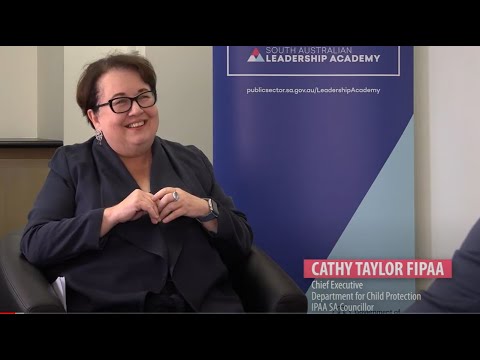
“We don’t want to leave any child in an at-risk situation”, Chief Executive, Department for Child Protection, Cathy Taylor FIPAA, emphasised this as being at the heart of her department’s response to COVID-19.
Ms Taylor also shared her insights on the challenges and opportunities her department is experiencing, and how they can continue to deliver services whilst keeping people safe.
Ms Taylor explored the below questions during this interview with Mark Thomson, Partner, PwC, throughout praising the overwhelmingly positive response from the community, NGO’s and her department.
The need for child protection doesn’t stop because of the coronavirus. What are you seeing in the world of child protection at the moment?
Given what you are seeing how has this event impacted your department?
At a very local level what have been your key focus areas, challenges and key initiatives of your department during this time?
What are you seeing on the ground and at the government level around this conversation?
Has data been elevated in importance for you through this event and do you think there are learnings for society about data? Has such a need arisen the space of Child Protection?
Crises can often kindle people’s innovation, strength, spirit and resilience. Which we are seeing on a daily basis as small businesses in particular innovate. What positive outcomes have you seen come out of the coronavirus?
What advice would you give to those leading teams at the moment?
Are there any leadership frameworks, models and mantras that you find particularly helpful during these times?
Given that there’s most likely some increased costs for carers in terms of access to Internet, technology devices and the like. Is there a plan to address this issue moving forward?
Those who are in processes such as foster care applications or any other involvement in the sector, should they expect any difference in sort of the timeframes that those processes typically run?
“We don’t want to leave any child in an at-risk situation”, Chief Executive, Department for Child Protection, Cathy Taylor FIPAA, emphasised this as being at the heart of her department’s response to COVID-19.
Ms Taylor also shared her insights on the challenges and opportunities her department is experiencing, and how they can continue to deliver services whilst keeping people safe.
Ms Taylor explored the below questions during this interview with Mark Thomson, Partner, PwC, throughout praising the overwhelmingly positive response from the community, NGO’s and her department.
The need for child protection doesn’t stop because of the coronavirus. What are you seeing in the world of child protection at the moment?
Given what you are seeing how has this event impacted your department?
At a very local level what have been your key focus areas, challenges and key initiatives of your department during this time?
What are you seeing on the ground and at the government level around this conversation?
Has data been elevated in importance for you through this event and do you think there are learnings for society about data? Has such a need arisen the space of Child Protection?
Crises can often kindle people’s innovation, strength, spirit and resilience. Which we are seeing on a daily basis as small businesses in particular innovate. What positive outcomes have you seen come out of the coronavirus?
What advice would you give to those leading teams at the moment?
Are there any leadership frameworks, models and mantras that you find particularly helpful during these times?
Given that there’s most likely some increased costs for carers in terms of access to Internet, technology devices and the like. Is there a plan to address this issue moving forward?
Those who are in processes such as foster care applications or any other involvement in the sector, should they expect any difference in sort of the timeframes that those processes typically run?
The work of a team of researchers from Edith Cowan University on innovative work behaviour in the public sector has been published in the March 2020 Issue of the Australian Journal of Public Administration.
Successive Australian governments have placed a high importance on innovation since the mid-2000s. However, the majority of research on organisational innovation is from the United States and Europe (see, for instance, the work of Anderson, Potočnik and Zhou, 2014). This new research by Dr Yuliani Suseno, Professor Craig Standing, Associate Professor Denise Gengatharen and Dr Diep Nguyen from the School of Business and Law at Edith Cowan University, helps correct this imbalance through the study of a large Australian public sector organisation.
WHAT IS INNOVATIVE WORK BEHAVIOUR?
Innovation work behaviour has been defined as the ‘behaviour directed towards the initiation and application… of new and useful ideas, processes, products or procedures’ (see De Jong and Den Hartog, 2007).
The work of a team of researchers from Edith Cowan University on innovative work behaviour in the public sector has been published in the March 2020 Issue of the Australian Journal of Public Administration.
Successive Australian governments have placed a high importance on innovation since the mid-2000s. However, the majority of research on organisational innovation is from the United States and Europe (see, for instance, the work of Anderson, Potočnik and Zhou, 2014). This new research by Dr Yuliani Suseno, Professor Craig Standing, Associate Professor Denise Gengatharen and Dr Diep Nguyen from the School of Business and Law at Edith Cowan University, helps correct this imbalance through the study of a large Australian public sector organisation.
WHAT IS INNOVATIVE WORK BEHAVIOUR?
Innovation work behaviour has been defined as the ‘behaviour directed towards the initiation and application… of new and useful ideas, processes, products or procedures’ (see De Jong and Den Hartog, 2007).
Anxiety and psychological distress are on the rise as our workforce adapts to the COVID-19 pandemic. More so than ever now is a time for leaders to shine through to guide and support their teams through these challenging times. Some leaders more so than others are better equipped to manage their staff virtually, but as most organisations don’t educate leaders on this area, many will struggle to adapt and find their feet in this new world.
Leadership during a pandemic is new and untested, where we are learning on the fly what does and does not work to manage staff in the virtual world. Human Psyhcology have shared with us essential advice for managers and team leaders in helping their team adapt. This includes;
Basic needs and technology use
Communication
Change benchmarks and engagement strategies
Mental health
Silver linings
Support
You can read and download the full tip sheet here.
A new initiative to bridge the gap between the research work of academics and the policy work of public servants was announced yesterday by ANZSOG Dean and CEO Ken Smith who said that public sector leaders needed access to research evidence when developing policy.
‘In these times of uncertainty, evidence-based policy and decision-making are more vital than ever.’
‘However, too often researchers lament that the public service ignores their work, while public servants say academic research is not timely or applied to their day-to-day challenges. The Bridge will make vital research available in an accessible format.’
The Bridge is distributed by ANZSOG each fortnight by email. It centres around a Research Brief which distills academic research into an easy-to-read format and will be complemented by other insights into public policy and management.
The Bridge is compiled and curated by Maria Katsonis — a former senior Victorian public servant with more than 20 years’ experience, who is now a Public Policy Fellow at the University of Melbourne. She was previously the curator of The Drop — a joint project between ANZSOG and The Mandarin. Maria is also one of the editors of the Australian Journal of Public Administration.