• Become a member
  • FAQs
  • Contact
  • Facebook
  • Twitter
  • Youtube
  • Linkedin
  • Vimeo
IPAA South Australia
  • Membership
  • About
    • People
    • History
    • IPAA National
  • News
  • Resources
  • Events and Workshops
    • Upcoming events and workshops
    • On the Couch Series
    • Events archive
    • Event management services
  • Training
    • Training Calendar
    • Extended Series
    • Career Pathways
    • View All Courses
    • In-Agency Programs
    • Professional Development Vouchers
IPAA South Australia
  • Membership
  • About
    • People
    • History
    • IPAA National
  • News
  • Resources
  • Events and Workshops
    • Upcoming events and workshops
    • On the Couch Series
    • Events archive
    • Event management services
  • Training
    • Training Calendar
    • Extended Series
    • Career Pathways
    • View All Courses
    • In-Agency Programs
    • Professional Development Vouchers
  • Become a member
  • FAQs
  • Contact
  • Facebook
  • Twitter
  • Youtube
  • Linkedin
  • Vimeo
  • Home
Where do you start in giving yourself an essential set of skills and capabilities that will provide the foundation for your public sector career? 

There can seem like so much to learn, and even after you find your footing, new challenges are just around the corner. To give you the tools and knowledge needed to tackle a range of tasks and projects you are presented with, we are helping you create your own unique training program.

The foundational skills for administrators courses include skills in key areas to increase your effectiveness in your role, which will:

  • Teach you how to perform and excel at essential tasks, such as; minute taking, proofreading, editing and writing.
  • Help you manage your time and workload, as well as work-life balance.
  • Increase your self-confidence in your own abilities and ready you for future opportunities.
  • Develop your capabilities in role-specific tasks, such as Executive Assistant or Personal Assistant duties.

Select four or more of the courses available below to add to your personal program, and you will receive 10% off the total cost of your training. If you are a State Government Employee this means you could save up to $225.
(registration into individual units is also available)


Click here to create your training program
or register for courses individually through the links available below.


We all have meetings and the ability to take effective minutes can be the difference between a meeting with positive outcomes or a wasted opportunity. Save yourself and your colleague’s stress and time by learning how to take efficient and highly readable minutes that tell readers exactly what they need to know. View full course outline >

DATE |  Tuesday, 6 Oct 2020

TIME | 9:00am to 12:30pm

FORMAT | face-to-face


In this highly demanding role, this course will equip you with the skills to become a more confident, skilled EA/ PA who can provide a superior level of support and service to all stakeholders and customers alike. From basic skills to more advanced strategies, here you will explore all aspects of your role. View full course outline >

DATE | Wednesday, 7 Oct 2020

TIME | 9:00am to 4:30pm

FORMAT | face-to-face


Enhance your productivity and reduce the level of stress due to your workload. Learn techniques to make a lasting improvement in your work-life, with better decision-making capabilities, prioritisation and being able to minimise procrastination. View full course outline >

DATE |  Tuesday, 13 Oct 2020

TIME | 9:00am to 4:30pm

FORMAT | face-to-face


Increase your confidence and efficiency in producing a range of written documents. Refreshing your understanding of grammar and punctuation will immediately up the quality of documents you produce or edit. View full course outline >

DATE |  Wednesday, 14 Oct 2020

TIME | 9:00am to 4:30pm

FORMAT | face-to-face


Learn about the positive psychology approach to being more confident and why developing optimism and utilising your strengths will help you gain confidence, increase your self-belief and reduce stress in the workplace and beyond. View full course outline >

DATE |  Monday, 26 Oct 2020

TIME | 9:00am to 12:30pm

FORMAT | face-to-face

foundations for administrators foundations for administrators
foundations for administrators
  • Home

The work of two Singapore-based researchers on the effects of ethical culture and ethical leadership on innovation as reported in the public sector has been published in the September 2020 Issue of the Australian Journal of Public Administration.

Examining the relationship between public sector ethics and public sector innovation is important because society has long expected employees and managers in public organisations to behave ethically, but increasingly also expects innovative and entrepreneurial behaviour. However, researchers have previously commented that these two behavioural expectations and the values they require may not necessarily align, and even compete in many cases.

Given that much of the evidence is rather anecdotal, and arguably outdated, Associate Professors Dr Zeger Van der Wal and Dr Mehmet Akif Demircioglu from the Lee Kuan Yew School of Public Policy at The National University of Singapore, have empirically examined how ethical culture and ethical leadership are associated with realised innovation using 84,222 responses from the Australian Public Service Commission’s 2017 APS agency survey. This research has produced robust findings across agency, work location, job level, tenure, education, and gender and across different samples.

SO WHAT IS ETHICAL LEADERSHIP? AND WHY CHOOSE THE AUSTRALIAN GOVERNMENT AS THE FOCUS FOR THIS RESEARCH?

The researchers used a definition of ethical leadership described in 2005 by Brown, Treviño and Harrison as:

‘The demonstration of normatively appropriate conduct through the personal actions and interpersonal relationships, and promotion of such conduct among followers through two-way communication, reinforcement, and decision-making processes’.

The researchers believed that the Australian public sector would provide a suitable environment for studying the effects of leadership and culture on public sector innovation for a number of reasons.

Firstly, the Australian government has been among the most highly ranked globally in terms of innovation and effectiveness for years (see the 2017 work of the OECD and Pollitt & Bouckaert). Secondly, it was also an early adaptor of New Public Management, implementing private sector practices and ideas from the 1980s onwards. And thirdly, the country’s public sector has consistently ranked highly in the Corruption Perception Index run by Transparency International.

Continue reading the full article and access the research paper via the IPAA National website.

  • Home

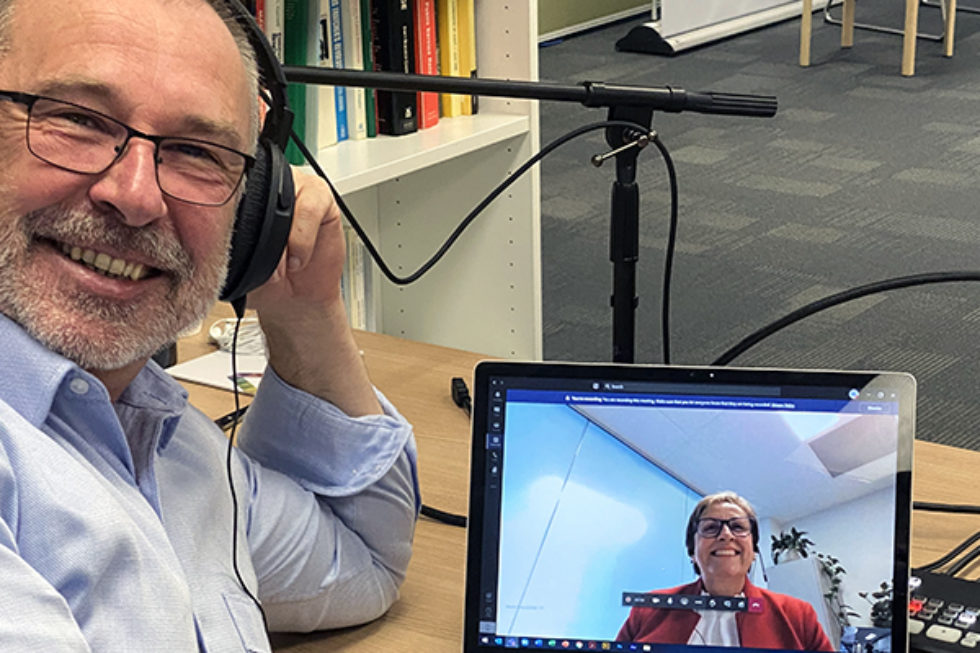
Erma Ranieri FIPAA, South Australia’s Commissioner for Public Sector Employment and IPAA SA President, joined IPAA ACT in the latest episode of their ‘Work with Purpose: A National Perspective’ podcast. In this interview Dr Gordon de Brouwer PSM FIPAA, IPAA National President, discussed the COVID-19 pandemic in South Australia.

“The clear message at the end of the day was that you keep talking to people”.

As highlighted by Commissioner Ranieri, while the pandemic presented a series of challenges it also showcased the real capability of the South Australian public sector.

“The innovation and resilience of the public sector were on display during this time, as they worked to support and collaborate with SA Health, SAPOL and other agencies to mobilise the sector to meet the unique needs of the pandemic. As the Mobilisation Coordinator, Commissioner Ranieri noted that this played a key role in the agile response to the pandemic.

“We have connected more than we have ever connected before”.

“COVID has shown what is possible within the public service”.

COVID-19 has also brought about a change to the existing paradigm for leadership and performance management in the workforce.  The Commissioner is encouraged to see great outcomes in flexible work arrangements which are “reshaping the workforce to be more adaptable and diverse”. Commissioner Ranieri’s office and IPAA SA will continue to focus on fostering the skills and capabilities leaders need to adapt to this rapid shift in the workplace.

The Commissioner also highlighted the importance of awareness of mental health and wellbeing and the materials available to help leaders and employees to manage the COVID-19 pandemic:

  • a Manager Toolkit  has been released to assist leaders navigate the challenges of COVID-19
  • a Mentally Healthy Workplaces Framework and Toolkit has been released to provide practical information and resources to support wellbeing strategies, and additional supporting guidance for the COVID-19 context.

The Office of the Commissioner for Public Sector Employment continues to work with agencies to implement a peer support program and develop an online training program for new peer support officers to build on the existing skills of employees trained in mental health first aid.

The COVID-19 Mental Wellbeing Interview Series, also offers valuable new resources for those working in the public service, with advice and tips from experts in the field

LISTEN HERE

Work with Purpose · A National Perspective – EP#4: COVID-19 has shown the public service what’s possible – with Erma Ranieri


RESOURCES

Open Your World.sa.gov.au


VIDEOS

– COVID-19 Mental Wellbeing Interview Series with Forensic Psychologist, Luke Broomhall

– COVID-19 Mental Wellbeing Interview Series with Chief Psychiatrist, SA Health, Dr John Brayley

– Virtual on the Couch with Commissioner Erma Ranieri

– All Virtual on the Couch interviews


Erma Ranieri Work With Purpose during COVID-19 Erma Ranieri Work With Purpose during COVID-19
Erma Ranieri Work With Purpose during COVID-19
  • Home

How are city administrations responding to the COVID-19 pandemic? And how might cities change as a result of the coronavirus?

Australia’s major cities have felt the full force of the health and economic crises brought on by the COVID-19 pandemic. It has challenged the assumptions of city officials towards the services they provide to the community, the way people interact within cities, and has come at significant financial cost to local governments.

Two recent interviews provide different perspectives on the impacts of COVID-19 to the cities and communities of Adelaide and Melbourne.

The first interview with Mark Goldstone — Chief Executive Officer with the City of Adelaide — was part of IPAA South Australia’s Virtual on the Couch series.

The second interview with Andrew Wear — Director of Economic Development at the City of Melbourne and author — was for the IPAA Victoria Public Sector Perspectives podcast.

In this article available through the IPAA National website we explore the unique experience of COVID-19 from the perspective of two different capital city councils. Read the full article here.

the Urban Impact of COVID-19 on Adelaide Vs Melbourne the Urban Impact of COVID-19 on Adelaide Vs Melbourne
the Urban Impact of COVID-19 on Adelaide Vs Melbourne
  • Home

With the recent ease of some restrictions in SA, we have been working with our Divisional Council and stakeholders to map the path forward for the institute. As always, the wellbeing of our staff, facilitators, and members is of the utmost importance to us.

  • To ensure the safety and wellbeing of all members and partners of the institute we aim to commence face-to-face professional development as of 1st September 2020.
  • We are closely monitoring government advice and if necessary, we will change our delivery format accordingly. In the event that it is necessary to cancel a course, all fees will be refundable.
  • As face-to-face learning becomes available, we will continue to enact COVID safe policies and procedures as based on the advice of the Australian Health Protection Principal Committee (AHPPC).
  • We have implemented numerous steps to continuously provide a safe and healthy environment including reduced class sizes, extra spacing between desks, single serve catering and enhanced cleaning and sanitising practices.
  • For those enjoying the convenience and ease of online learning, we will continue to offer courses in a virtual format to ensure our members can attend courses in a format they are comfortable with and find most convenient.
  • Events and forums will continue in virtual formats until September 2020.
  • Over the coming weeks, we will continue to expand our range of available online training and events, to bring you relevant and useful learning to grow your capabilities.
  • We have already commenced offering face-to-face, online or mixed mode In-agency delivery of courses and programs in accordance with the individual policies of departments and organisations.

We would like to thank all our members for their commitment and contributions during this time and look forward to embedding all that we have learnt from this experience to continue working to improve the standing of the public sector in South Australia.

Kind Regards,

Renae Haese

Executive Director

IPAA SA

  • Home

Forensic Psychologist, Luke Broomhall joins us in the latest instalment of the COVID-19 Wellbeing – Interview Series. Mr Broomhall shares his tips and advice for leaders, managers and team members on how they can look after their own mental health and that of others.


How can leaders check in on the mental health of their team members?

Mr Broomhall urges us to look out for behaviours that sit outside the norm for that person, such as bouts of tearfulness, withdrawal, or anger. If so be prepared to sit down and open up a conversation with this person on the behaviours, you have noticed.

You might like to start the conversation by saying…

“  [Name} I have noticed lately that you seem a bit more [describe the behaviour e.g. withdrawn and quiet] and [these goals or items haven’t been met] and I’m a bit concerned about you and I just want to know if you’re okay and if there’s anything I can do?”

The role of the manager or leader when handling the response to this question is to have a human response grounded in empathy, but to also understand what they can and can’t control, and in turn to provide resources for the individual to access that will support them. When you encounter a strong emotional response from an individual you can respond to them as described below:

  1. Demonstrate empathy for the emotion that is occurring by acknowledging the emotion exists and that you can see that they are experiencing this.
  2. Affirm that their experience of this emotion is valid and okay, and that you are there to listen and help in whatever ways that you can control.

“I understand you are feeling this way, tell me more about your experiences and what you are going through at the moment”

  1. Take the time to listen and not jump in too soon with solutions.
  2. Act to change what you can for the wellbeing of the individual and provide access to support resources and persons as needed.
Returning to the Workplace

In the transition back into the physical workplace there are several measures and tips that leaders and managers can employ to ease people into the ‘new normal’ of post-COVID-19 work.

  • Be patient while employees’ transition.
  • Ensure workplaces do not grow complacent with preventative COVID-19 measures.
  • Be aware that not all staff members will be positive about the return to the workplace and should be aware of this as a flag for potential issues around conflict, bullying and other concerns.
  • Encourage the access of Employee Assistance Programs for early intervention.
  • Develop and grow the mental health literacy of leaders and managers.
How Can We Help a Colleague or a Friend Who is Struggling?

We all want to be able to help and support our friends and colleagues when we can see they may be experiencing mental distress. Mr Broomhall shares that we can all take an active role in checking in with others during this time, but firstly you must:

  1. Fit your own oxygen mask first – make sure you are in a balanced and centered place and ask yourself continuously ‘Am I coping okay myself?’, as it is very hard to look after other people if we are in a difficult space ourselves.
  2. Focus on the behaviours you can see when discussing your concerns, refrain from saying that they seem more depressed or anxious, instead note that they may have been more withdrawn tearful, etc.
  3. Provide an opportunity for them to speak openly with you, for example go for a casual coffee or walk together building on social connection.

If you have had a chance to view this interview, please provide your thoughts here.

Tips for Wellbeing COVID-19 Tips for Wellbeing COVID-19
Tips for Wellbeing COVID-19
  • Home

The Australian and New Zealand School of Government (ANZSOG) will be presenting a three-part webinar series on ‘Leading People Through Disruption’, beginning on 25 August 2020.

The series will be presented by Dr Jo Cribb — one of the youngest people ever appointed as a chief executive in the New Zealand public service in 2012. Her work has focused on advancing the cause of vulnerable in society, spearheading some of the most difficult issues of our time, including child abuse, child poverty, family violence and vulnerable women.

The webinar series will give participants insights into how to make decisions during a time of crisis and maintain an inclusive and positive style of leadership.

Dr Cribb said that effective leaders created change in a values-based way, and the best were able to empower their staff and admit the limits of their own knowledge and ability.

‘Leadership is about mobilisation, bringing people together and making things better than they were before. You can have that influence at every level and everyone can be part of the leadership team’.

Dr Cribb also said that organisations were too complex and the problems that they had to deal with were too difficult for one person to have all the answers. Leaders needed to be honest and admit they don’t know everything —something particular true in the context of the COVID-19 crisis.

‘It is really important for authorities to be honest about what they don’t know when they communicate with the public.

This has been the experience in New Zealand and it has actually strengthened trust in government. We have been able to communicate really complex judgement-based policies and do so effectively.’

The first webinar will focus on leading people through disruption (25 August 2020).

The second webinar will explore what it means to be an inclusive leader under pressure (3 September 2020).

And the third webinar will look at ways to build an inclusive culture during crises (17 September 2020).

Those interested in participating in this series can register on the ANZSOG website.

Author: Frank Exon, Executive Director, IPAA National

  • Home

For Chief Executive, Department for Health and Wellbeing, Dr Chris McGowan, the pandemic response has been a showcase of collaboration and innovation. In this Virtual on the Couch interview, Dr Chris McGowan discussed how his department structured their response to the COVID-19 pandemic by identifying 6 streams of work to achieve their 3 goals being “Flatten the Curve, Optimise the Public Health System and Keep Public Confidence”. Dr McGowan was interviewed by Tricia Tebbutt, Partner, PwC, where they explored Dr McGowan’s insights into the pandemic and responded to questions from the IPAA SA community and broader public sector.

Questions to Dr McGowan included…

  • Looking back on the last 3 months, what where the biggest challenges you faced and how did you respond?
  • Communication is key. What are some examples of how you communicated with your team and the wider SA Community?
  • What was it like in your department during the early weeks of the pandemic?
  • Where there some surprises during the early weeks that you weren’t expecting?
  • What do you think are some of the opportunities that have occurred that you want to take with you into the future?
  • What did you learn about yourself as a leader over the last few months?
  • How do you think SA can help demonstrate further support in developing leadership and emerging future leaders?
  • What’s the focus and priorities of SA Health over the next 6 months as we move into recovery?
  • What do you think would be the lasting legacy of COVID-19, both positive and negative?
  • The stabilization of the COVID-19 situation means moving from prioritizing suppression to focusing on detection to protect SA as we move into the recovery period.

As highlighted by Dr McGowan, support for emerging and developing leaders is essential. Learning and capability development is an important steppingstone in the leadership journey, providing the opportunity for self-reflection and growth. If you would like to learn more about leadership training opportunities are available both through the South Australian Leadership Academy and IPAA SA.

If you have watched this interview please feel free to leave your feedback and comments here.

  • Home

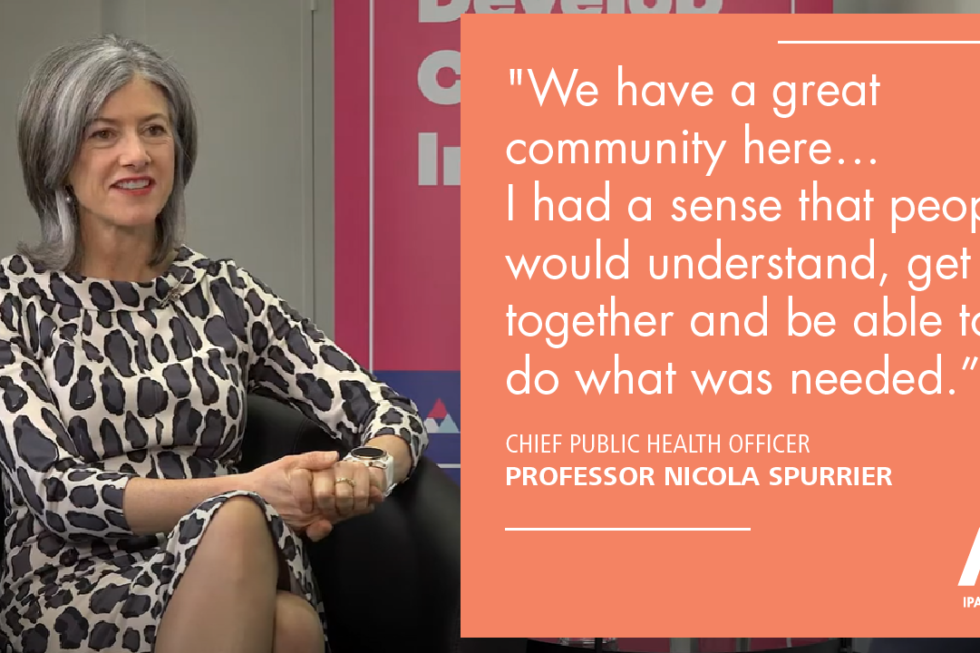
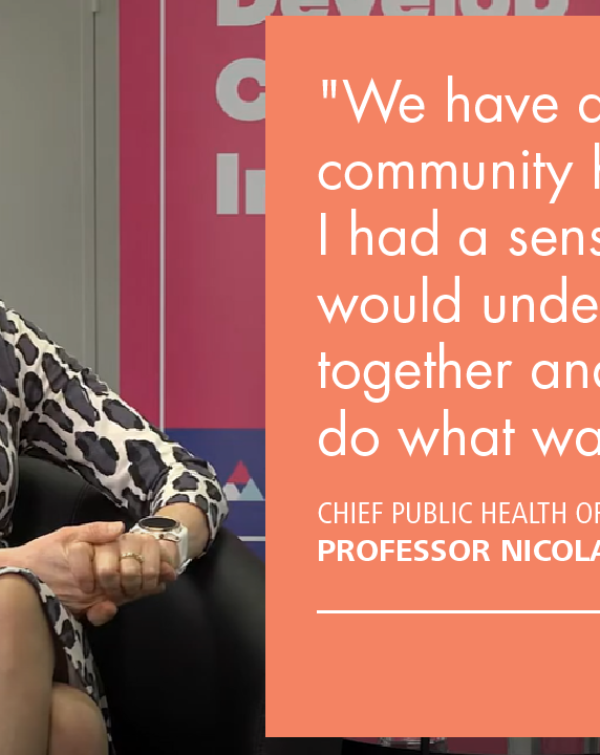
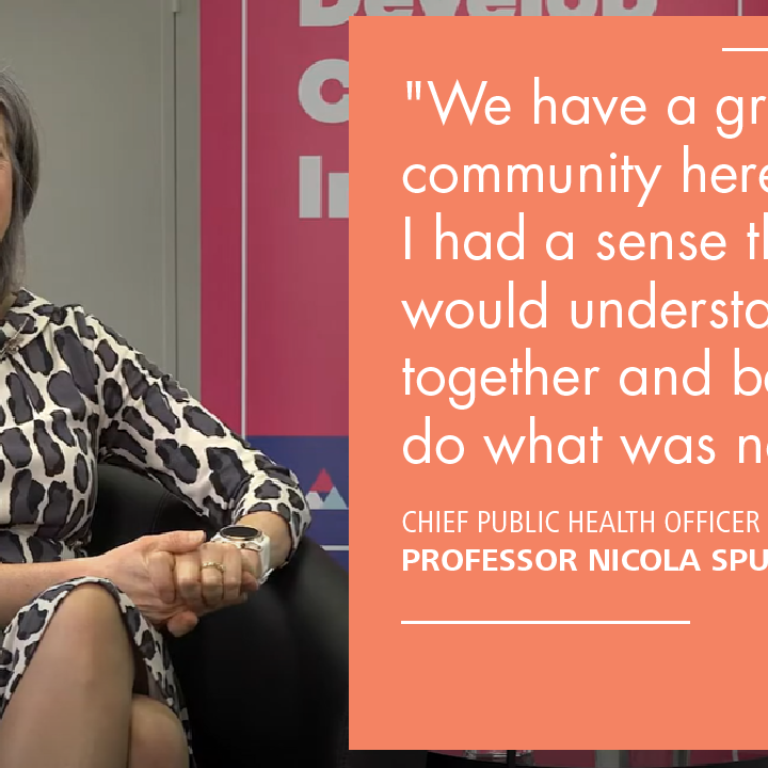
Chief Public Health Officer, SA Health, Professor Nicola Spurrier has joined us virtually ‘On the Couch’ to share how the response to COVID-19 has evolved over the course of the year, and in turn what the future may look like as we face a new “normal”. Professor Spurrier highlights the fantastic work of her team and supporting organisations, as well as the commitment of everyone in the state to suppressing the spread of the virus through social distancing and other restrictions.

“we have a great community here….I had a sense that people would understand, get together and be able to do what was needed”

Professor Spurrier was interviewed by Adelaide Managing Partner, PwC, Jamie Briggs, where they explored responses to the following questions.

  • How regularly do novel coronaviruses appear? Is this one particularly virulent?
  • Why did we do so well in South Australia [in our response to COVID-19]?
  • Was the success of the COVID-19 response common across the country or unique to SA?
  • How much more do we know now, than January 1st about the virus?
  • How much work went into the preparing for the pandemic in early 2020 as the virus situation developed?
  • How much is the national group learning from the outbreak in other places around the world, where there isn’t as much control?
  • Where is the vaccine and where are the treatments? Where do you think we are at?
  • Is where we are at, where you think we will stay for the next 6-months according to the Transition Committee?
  • Being front and centre of the media’s interest how have you handled the attention over the last few months? How has that impacted on you personally?
  • Do you think that COVID-19 will have longer time impacts on the way that we live?
  • Are you worried about a breakout here – if it does happen as in Melbourne?
  • Is Winter and cold and flu season going to impact the pandemic situation? Are people able to get the virus twice?
  • In a world where global pandemics and the like may become more common, do you think there will be more of an emphasis on public health in the coming years?
  • How does a good and bad scenario for Victoria play out from this point forward?
  • Looking back would you do anything differently?


Leave your feedback on this event here.

  • Home

The latest issue of the Australian Journal of Public Administration contains a gem of a research paper by Catherine Althaus on the exciting contribution that Indigenous evidence and knowledges can make to public administration in the fields of engagement, sustainability, and policy innovation.

Catherine Althaus is the Professorial ANZSOG Chair of Public Service Leadership and Reform at the Public Service Research Group at UNSW Canberra and ANZSOG Deputy Dean. She is a non-Indigenous academic woman who has been privileged by the great generosity and hospitality of Indigenous peoples from across Australia, New Zealand, and Canada. She has also observed with frustration the many barriers to the contribution of Indigenous knowledges in the scientific and policy-making realms.

Her paper — Different paradigms of evidence and knowledge: Recognising, honouring, and celebrating Indigenous ways of knowing and being — proposes that public administration can benefit from these Indigenous ways of knowing and being.

Catherine starts by tracing some of the contemporary reasoning in favour of such acknowledgement and prioritisation. She then turns to practical examples to demonstrate how the field of public administration and the practice of policymaking will benefit (including a discussion on the potential barriers to uptake). And she closes with a call for dedicated and respectful work by the discipline and practitioner communities.

Read the full article here>

Top
IPAA South Australia

© Institute of Public
Administration Australia
South Australian Division 2026

  • Privacy
  • Disclaimer
  • Site map
  • IPAA SA Constitution
  • Contact
  • Networking

Connect with us

  • Facebook
  • Twitter
  • Youtube
  • Linkedin
  • Vimeo

© Institute of Public
Administration Australia
South Australian Division 2026

  • Privacy
  • Disclaimer
  • Site map
  • IPAA SA Constitution
  • Contact
  • Networking

Connect with us

  • Facebook
  • Twitter
  • Youtube
  • Linkedin
  • Vimeo
  • Subscribe to our newsletter

  • This field is for validation purposes and should be left unchanged.

Connect with us

  • Facebook
  • Twitter
  • Youtube
  • Linkedin
  • Vimeo

© Institute of Public
Administration Australia
South Australian Division 2026